When Fibonacci numbers
meet their reflection.
Mirror a Fibonacci sequence, take adjacent differences, and watch nested triangular voids emerge. Move the sliders to explore the geometry, its binary arithmetic, and the counting laws behind it.
An interactive exploration developed with ChatGPT, bringing the supplied atlas versions and sequence comparisons together in one research notebook.
01 / Build the triangle
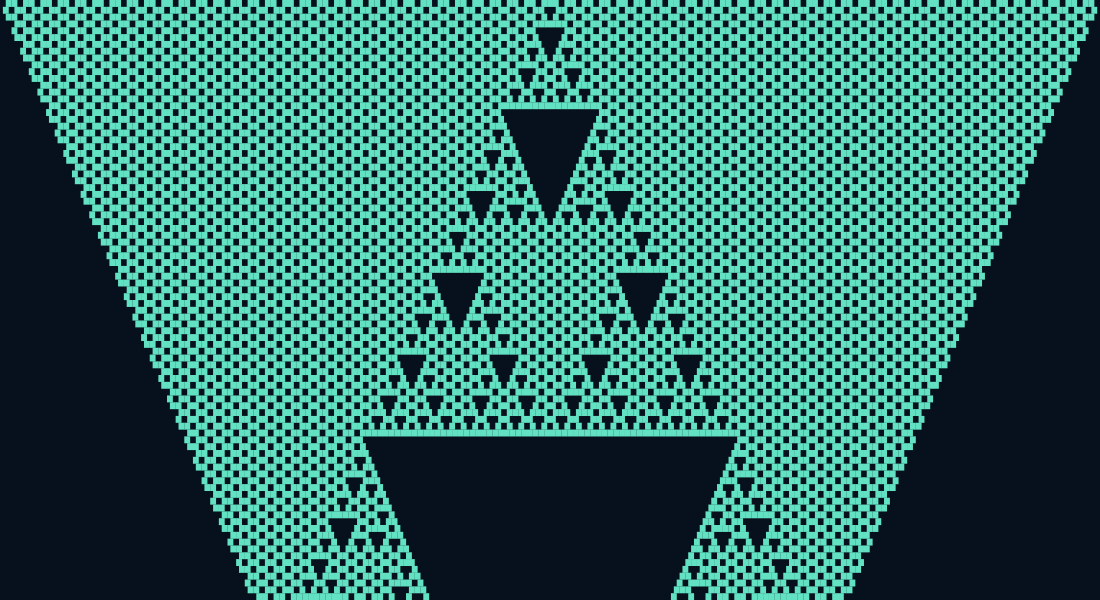
The top row is Fₙ, …, F₂, F₁, F₂, …, Fₙ. Each subsequent row XORs adjacent parity values. Try increasing the number of terms, switching the mirror phase, or inspecting individual cells.
02 / The local rule creates the geometry
The XOR rule
Every cell depends only on the two directly above it. Change the inputs to see the result.
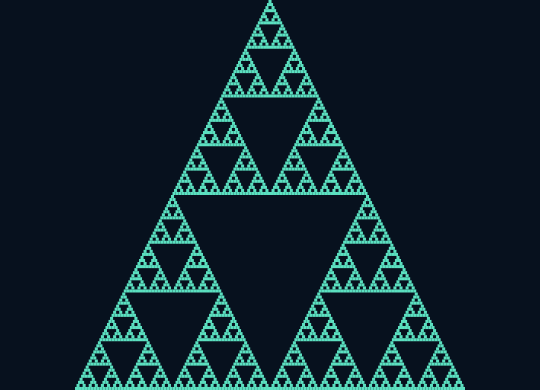
Pascal's triangle modulo two
Odd binomial coefficients form the Sierpiński pattern. Increasing the scale adds three self-similar copies.
Why powers of four?
At a dyadic row q = 2ᵐ, the characteristic-two identity simplifies the entire difference operation:
Fibonacci parity repeats every three terms. Since 2ᵐ alternates between 1 and 2 modulo 3, the full central zero strip occurs at q = 1, 4, 16, 64, …
03 / Discover newborn zero triangles
A maximal run of at least three ones, bounded by zeros, creates a new interior zero triangle one row later. The triangle's width depends on the number of trailing zero bits in its birth row.
Exact width theorem
When a new maximal interior zero triangle of width ≥ 2 is born at row r, its width must have this form. It is not a claim that every row contains a birth.
Candidate mechanism
The odd blocks of Pascal row r−1 identify possible birth locations. A candidate becomes an actual triangle when two neighboring parity bits in the preceding difference row are both 1.
04 / Counting triangles across scales
The candidate count is a direct consequence of Lucas' theorem. The accepted count for the bi-infinite seed is described in the supplied notes as following from a finite-state computer-assisted certificate; it is not interchangeable with a truncated finite triangle count.
Candidate count · elementary proof
Each free binary digit contributes three submask choices. Summing the resulting powers of three gives this exact expression.
Accepted count · supplied research result
The supplied atlas attributes this formula to a finite-state calculation. This chart evaluates the formula; it does not independently enumerate or verify the certificate.
05 / From observation to proof
1 · The mirrored seed
Fibonacci parity has period three. The mirror introduces a localized defect in an otherwise periodic recurrence.
2 · Linear evolution
Lucas' theorem turns the binomial expansion into a binary-submask formula.
3 · The width theorem
Maximal consecutive odd runs in Pascal row r−1 control the newborn zero-triangle widths.
4 · Finite-state counting
The supplied notes describe a 146-reachable-state exact-integer certificate. The certificate itself was not included with these attachments; this statement remains to be independently audited.
Source note: compiled from the two supplied interactive atlas versions and the supplied comparison images. A separate manuscript and proof certificate were not included. Mathematical claims from the atlas are presented as research notes, with computational illustrations rather than independent proof verification.
06 / Compare the sequence families
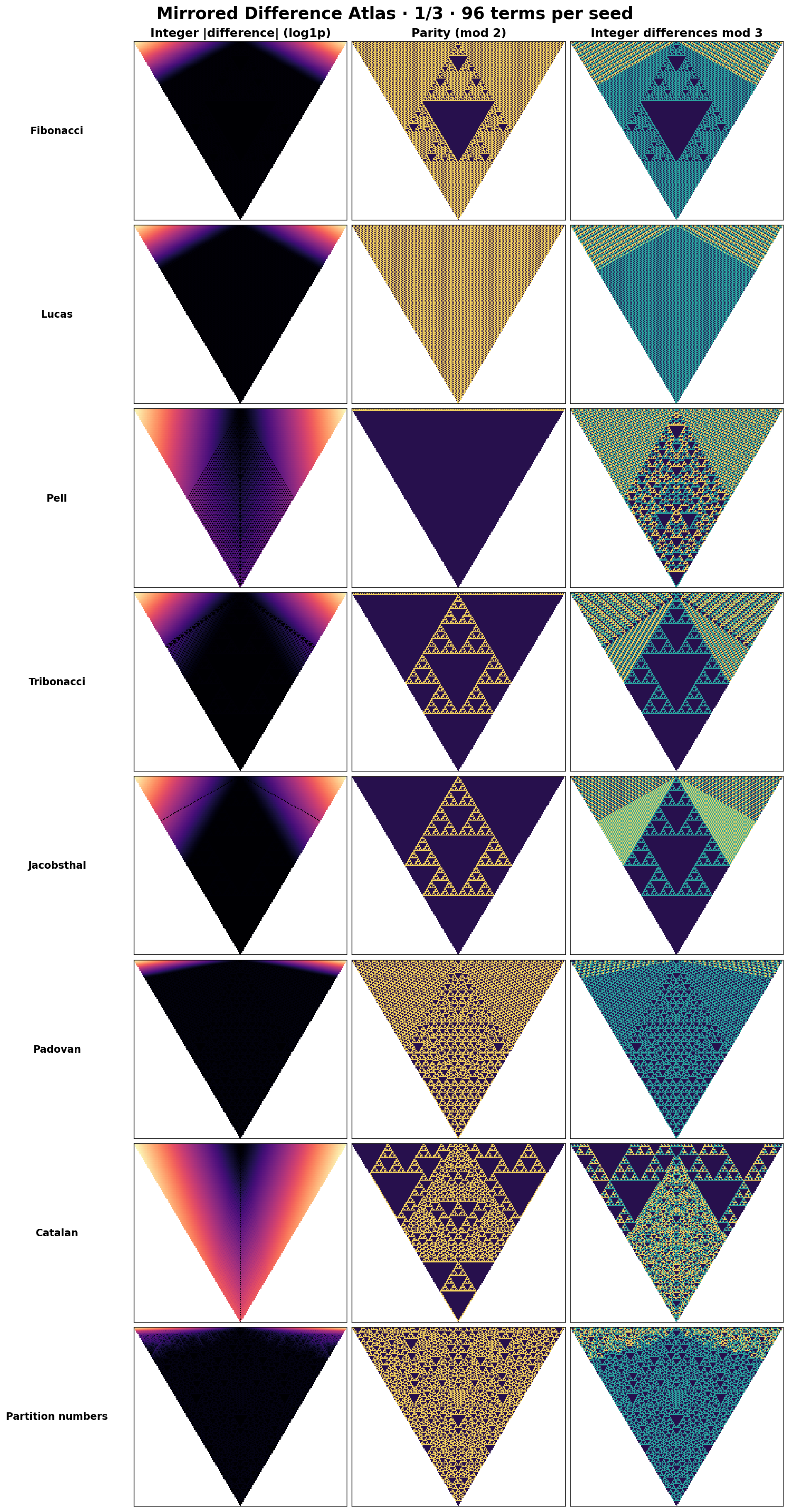
The supplied image atlas compares mirrored integer absolute differences, their parity, and their residues modulo 3. Each sheet uses 96 terms per seed. These are original research figures; the controls above explore Fibonacci parity.