Lesson Map
Curriculum extension: lessons 4.0A–4.0D, 4.2/4.3 proof extensions, and 4.6A–4.6C appear in the Added Standards section. They do not change the numbering of your existing quizzes.
Unit 4 is organized to prepare students for two quiz checkpoints. The major improvement here is that each lesson now has a visual anchor so students first learn what the diagram should look like before they begin calculations.
| Lesson | Focus | Assessment connection | Visual emphasis |
|---|---|---|---|
| 4.1 | Identifying Similar Figures | Quiz 1: similar / not similar, scale factor | Matching angle arcs, corresponding side marks, ratio comparison |
| 4.2 | Proportions in Similar Triangles | Quiz 1: solve for missing sides with parallel lines | Parallel marks, split-side labels, triangle correspondence |
| 4.3 | Right Triangle Similarity | Quiz 1: altitude to the hypotenuse | Three similar triangles, right-angle markers, side table |
| 4.4 | SOH-CAH-TOA | Quiz 2: find missing sides | One fixed triangle with opposite, adjacent, and hypotenuse labeled |
| 4.5 | Inverse Trigonometry & Applications | Quiz 2: missing angles and angle of elevation | Context sketches, angle placement, inverse trig setup |
Visual problem-solving routine
Draw or copy the diagram.
Label the known values and the unknown.
Name the rule, proportion, or trig ratio.
Solve and check if the answer makes sense in the picture.
Content Summary
Identifying Similar Figures
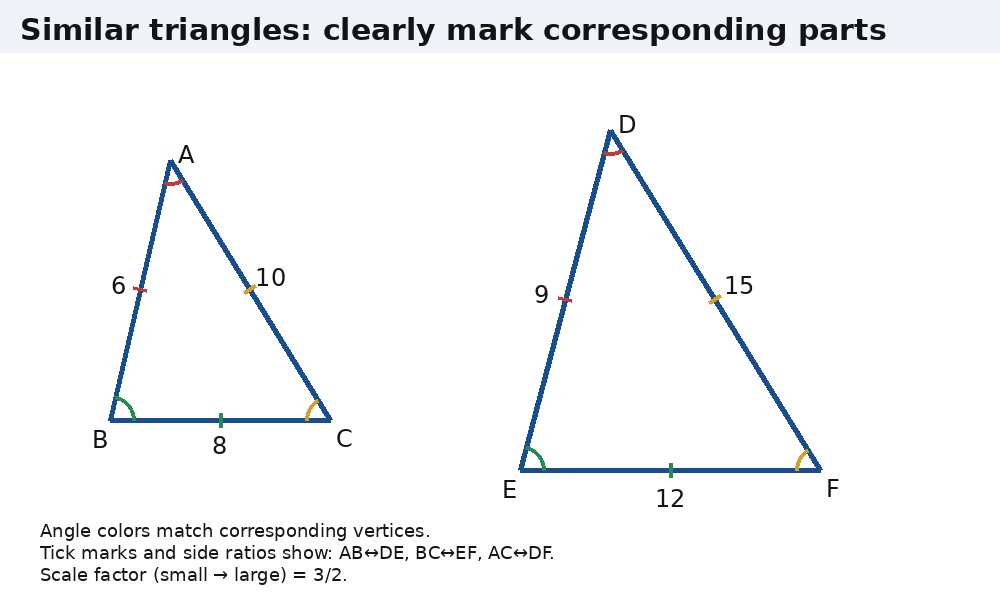
Big idea: Similar figures have the same shape but not necessarily the same size. To prove figures are similar, show that corresponding angles match and that corresponding side ratios are equal.
- Find the matching vertices first.
- Write side ratios in the same order.
- State the scale factor in the requested direction.
Proportions in Similar Triangles
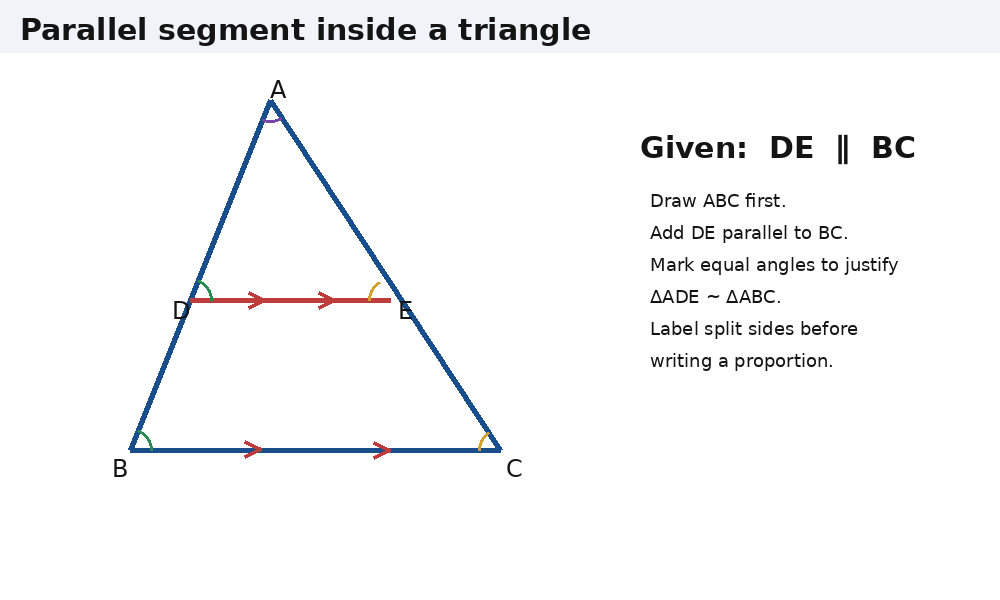
Big idea: When a segment is parallel to one side of a triangle, it creates a smaller triangle that is similar to the original triangle. Similarity lets us write proportions to solve for missing side lengths.
- Say the similarity statement first: for example, ΔADE ~ ΔABC.
- Be careful not to mix a full side with only a side piece unless the equation is set up correctly.
- Use the diagram to justify why sides correspond.
Right Triangle Similarity: Altitude to the Hypotenuse
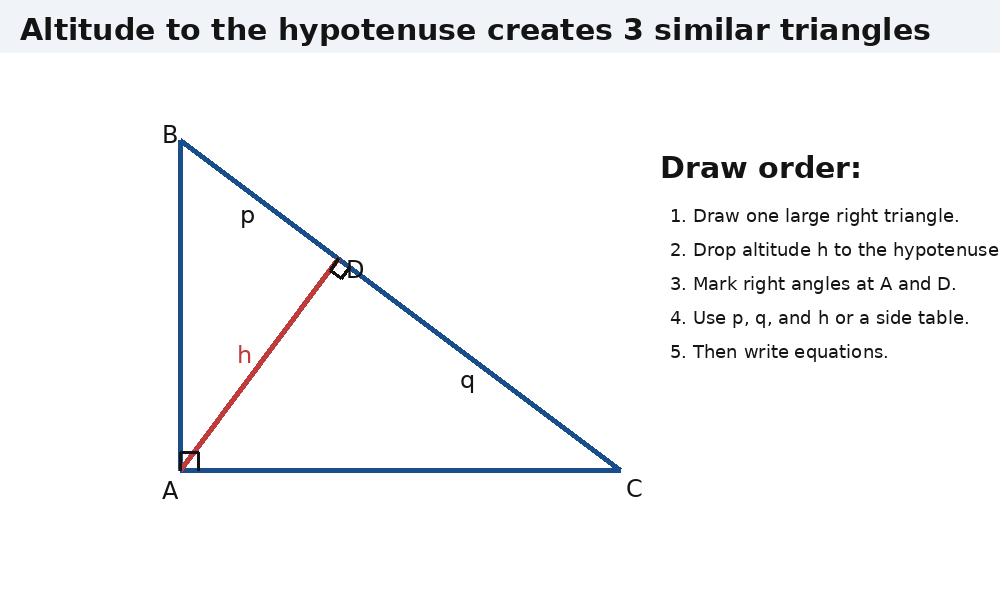
Big idea: Dropping an altitude from the right angle to the hypotenuse creates three similar triangles. This is easier to use when students visually organize the triangles before solving.
Trigonometric Ratios — SOH-CAH-TOA
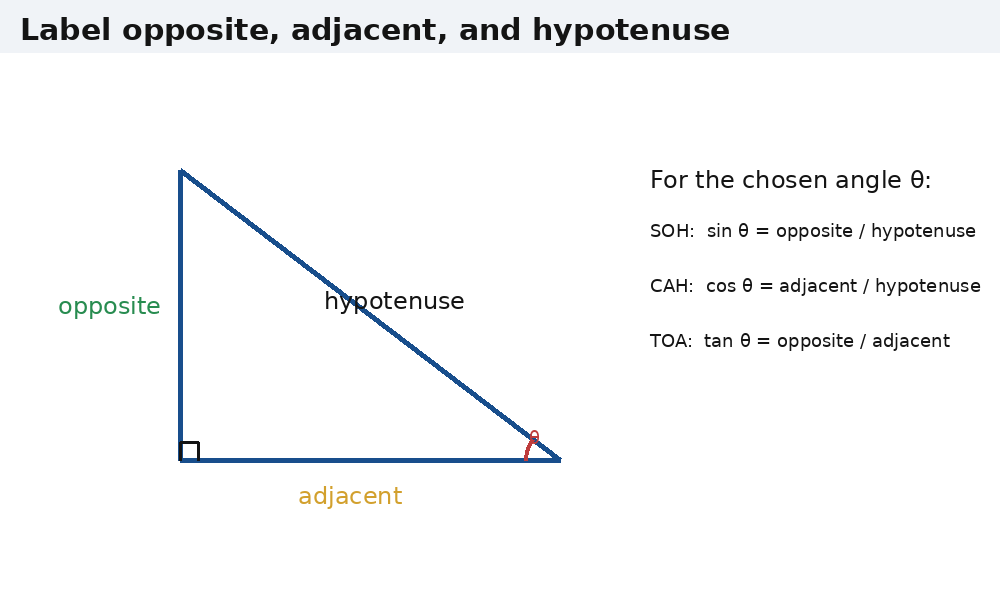
Big idea: In a right triangle, the names opposite and adjacent depend on the chosen angle. Students understand trig better when they learn the ratios from one clearly labeled image.
- sin θ = opposite / hypotenuse
- cos θ = adjacent / hypotenuse
- tan θ = opposite / adjacent
Inverse Trigonometry & Angle of Elevation
Big idea: If the unknown is an angle, use inverse trig. In application problems, students should turn the words into a right triangle sketch before writing any equation.
- Use inverse trig when solving for an angle.
- Keep the angle of elevation at the observer, not on the building or object.
- Use tangent often in elevation problems because it compares height and horizontal distance.
Vocabulary
Similar figures
Figures with the same shape. Their corresponding angles match and their corresponding side lengths have a constant ratio.
Scale factor
The ratio that compares the image to the original. Always pay attention to the order.
Corresponding parts
Matching sides or angles that appear in the same relative position in similar figures.
Hypotenuse
In a right triangle, the side opposite the right angle. It is always the longest side.
Opposite / adjacent
These names depend on the selected reference angle. They are not fixed labels for a triangle.
Angle of elevation
The angle measured upward from a horizontal line of sight to an object above the observer.
Sample Problems
These examples intentionally begin with images so students can see the structure of the problem before they read the algebra.
Sample 1 · Similar or not similar?
Show solution steps
- Match the corresponding sides: AB ↔ DE, BC ↔ EF, and AC ↔ DF.
- Write the ratios in the same order: 9/6, 12/8, and 15/10.
- Each ratio equals 3/2, so the triangles are similar.
- The scale factor from smaller to larger is 3/2.
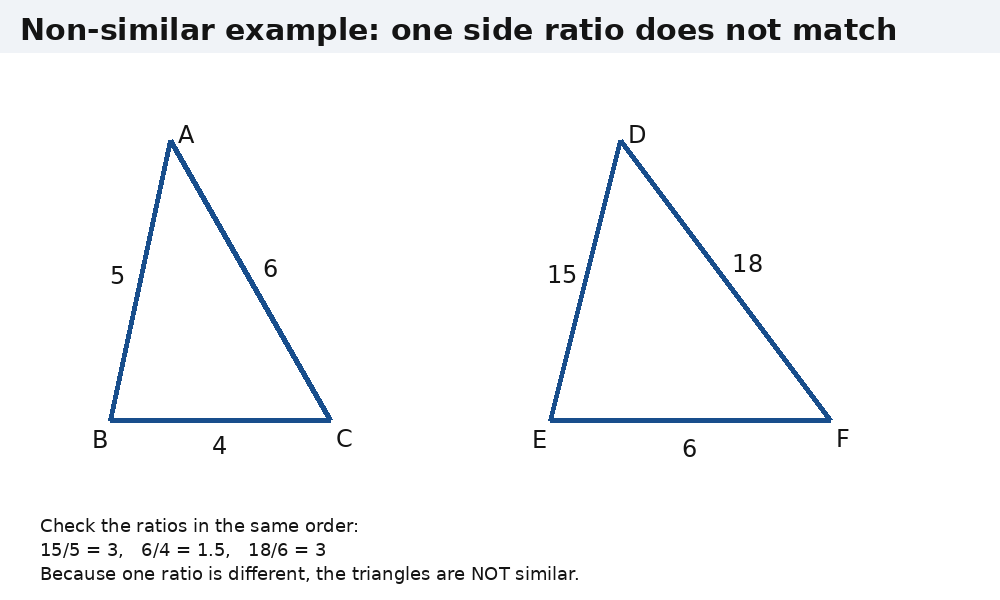
Sample 2 · A non-similar example
Show solution steps
- Compare the matching side ratios in order.
- 15/5 = 3, 6/4 = 1.5, and 18/6 = 3.
- Because the ratios are not all the same, the triangles are not similar.
Sample 3 · Similar triangles with a parallel segment
Show solution steps
- Because DE ∥ BC, corresponding angles are equal.
- This gives ΔADE ~ ΔABC by AA similarity.
- One valid proportion is AD/AB = AE/AC.
- Equivalent ordered proportions are also acceptable.
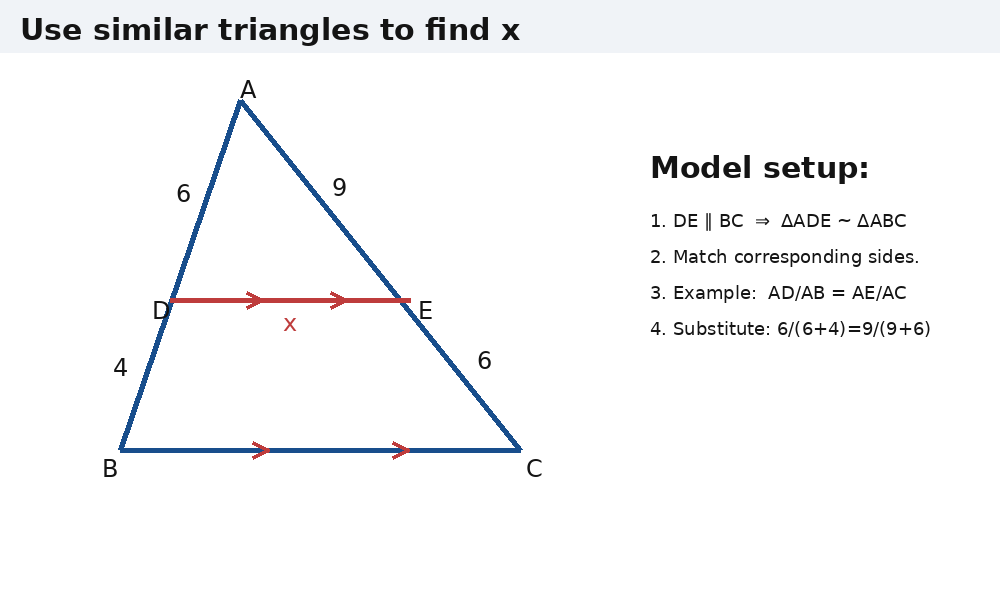
Sample 4 · Solve for a missing side in similar triangles
Show solution steps
- Because DE ∥ BC, the triangles are similar.
- Use the matching order: AD/AB = AE/AC.
- Substitute the full side lengths: 6/(6+4) = 9/(9+6).
- AB = 6 + 4 = 10 and AC = 9 + 6 = 15. The ratio is 6/10 = 9/15 = 3/5.
- Because BC is not given, the length DE = x cannot be uniquely determined. One additional side measurement is needed.
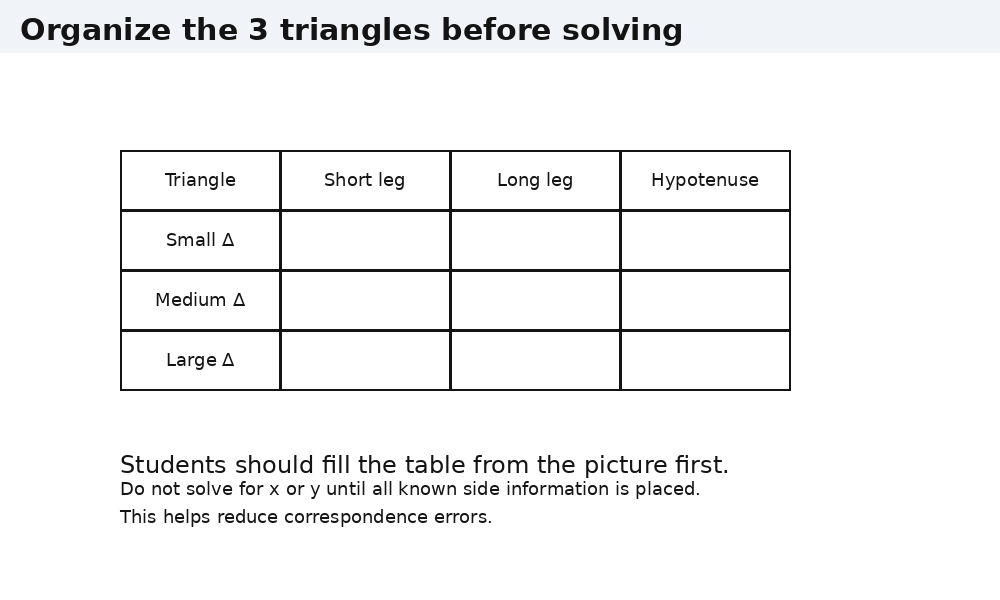
Sample 5 · Altitude to the hypotenuse
Show solution strategy
- Identify the three triangles: small, medium, and large.
- Mark the hypotenuse of each triangle separately.
- Fill in a side table before you write any equation.
- Use the appropriate similarity relationship or geometric mean equation.
Sample 6 · Applying SOH-CAH-TOA
Show solution steps
- Relative to θ, the unknown is the opposite side and 20 is the hypotenuse.
- Use sine: sin(38°) = x/20.
- Solve: x = 20·sin(38°).
- x ≈ 12.3.
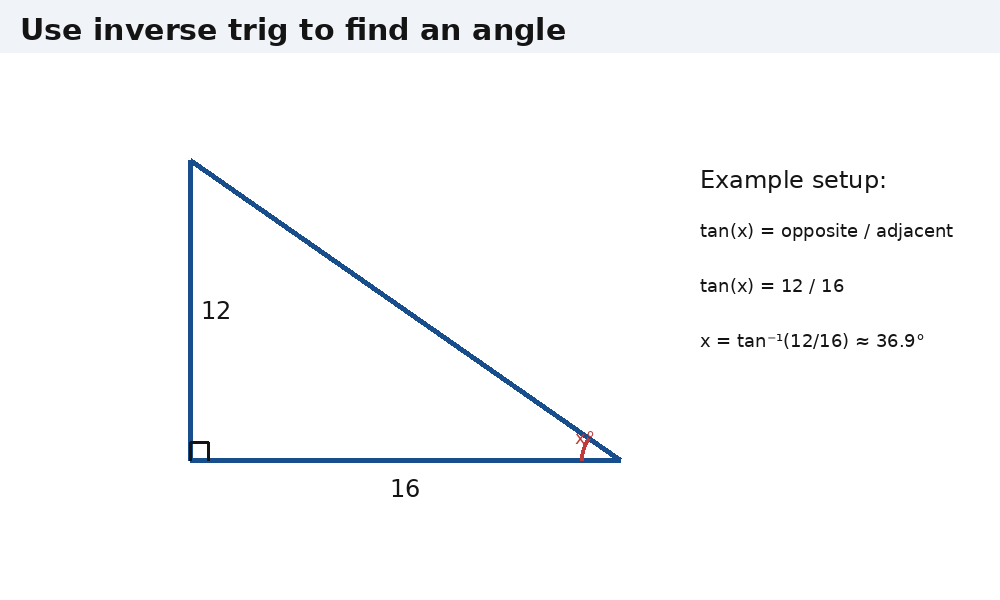
Sample 7 · Using inverse trig to find an angle
Show solution steps
- Relative to angle x, the opposite side is 12 and the adjacent side is 16.
- Use tangent: tan(x) = 12/16.
- Use inverse tangent: x = tan⁻¹(12/16).
- x ≈ 36.9°.
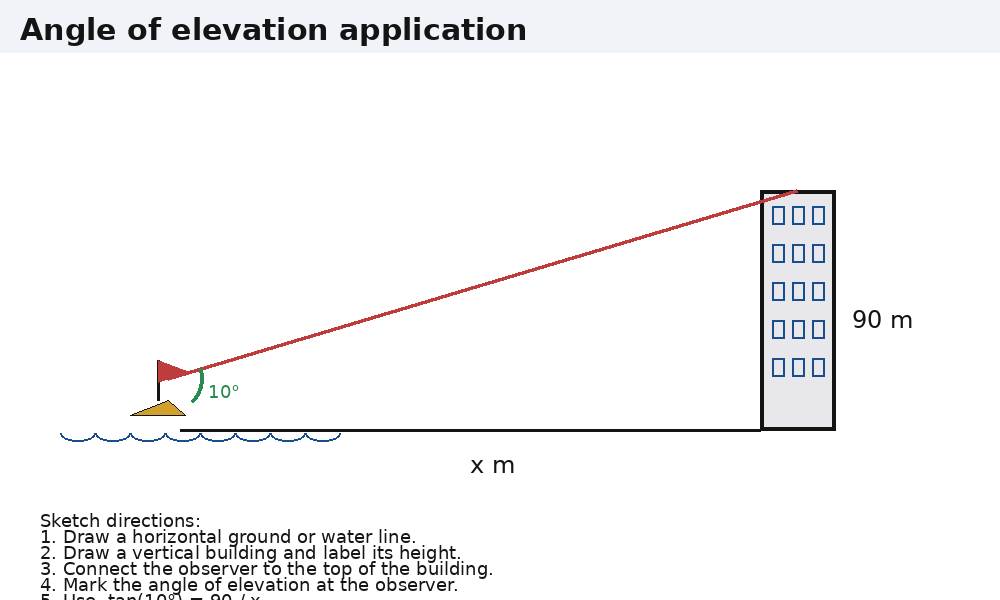
Sample 8 · Angle of elevation
Show solution steps
- The opposite side is 90 m and the adjacent side is x.
- Use tangent: tan(10°) = 90/x.
- Solve: x = 90 / tan(10°).
- x ≈ 510.4 meters.
Additional Visual Examples: Circles, Polygons, and Proofs
These examples broaden Unit 4 beyond simple triangles. Use them to help students transfer the same reasoning habits—draw, label, justify, solve—to circles, polygons, and proof settings.
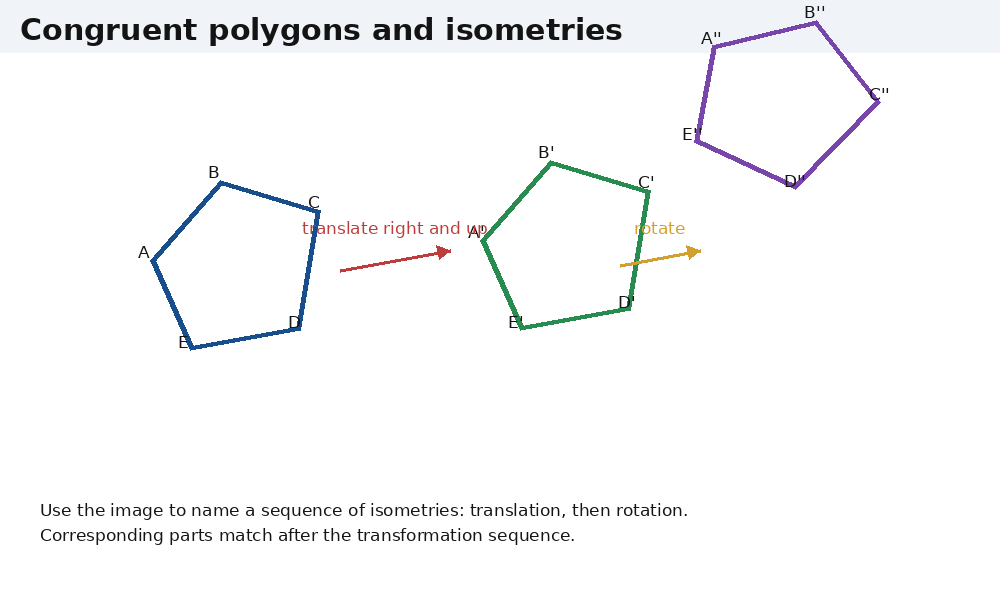
Visual Example A · Congruent polygons and a sequence of isometries
Show solution idea
- The first polygon is translated to the right and slightly upward.
- Then the image is rotated to match the orientation of the final polygon.
- Because translations and rotations are isometries, side lengths and angle measures are preserved.
- Students can then name corresponding vertices in matching order.
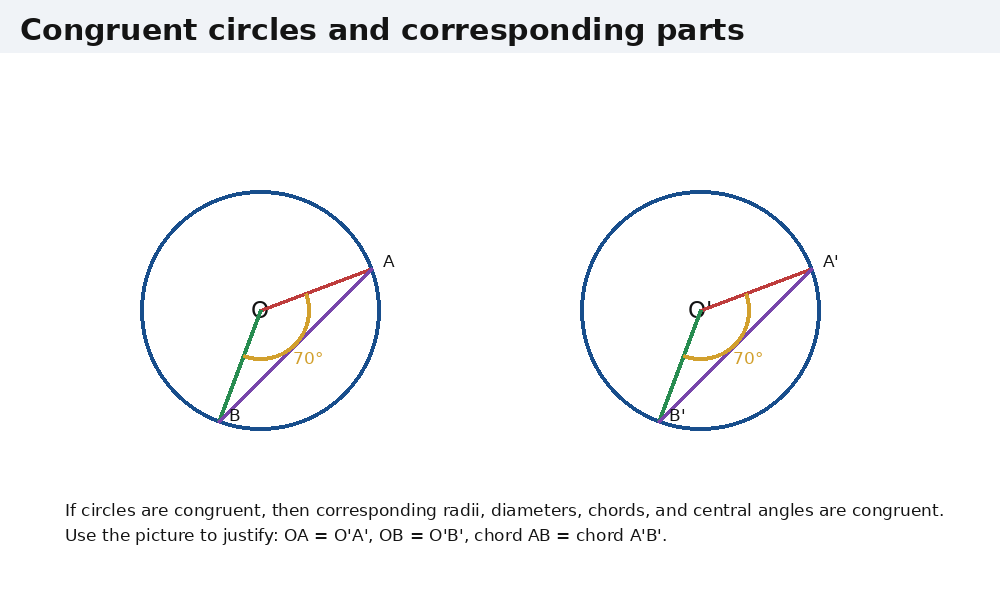
Visual Example B · Congruent circles and corresponding parts
Show a sample question and answer
Question: If ∠AOB = 70°, what can you conclude about ∠A'O'B' and chord A'B'?
- Since the circles are congruent, corresponding radii match.
- The marked central angles correspond, so ∠A'O'B' = 70°.
- Congruent central angles in congruent circles intercept congruent chords, so AB ≅ A'B'.
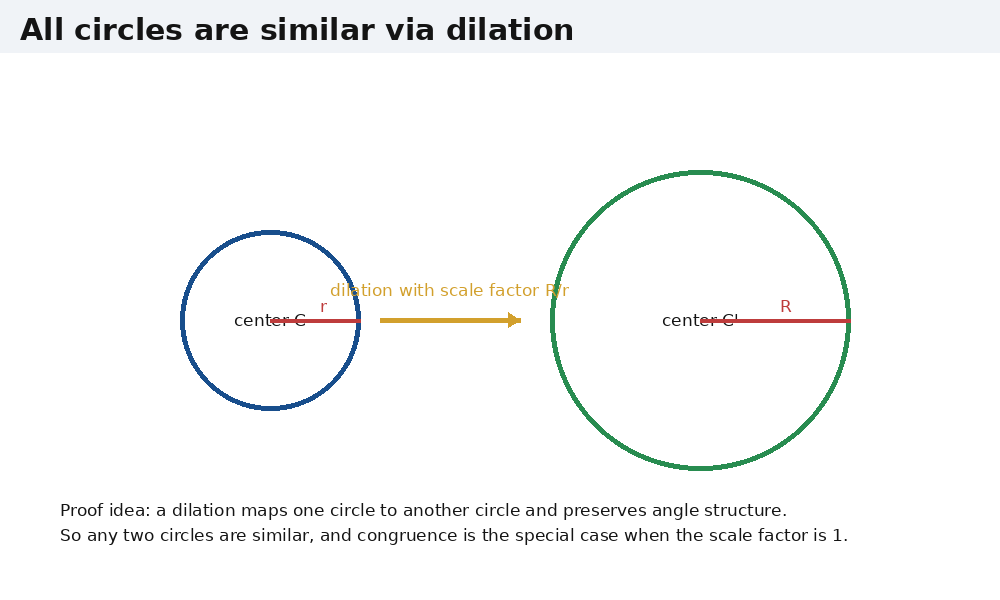
Visual Example C · Proof that all circles are similar
Show proof outline
- Start with a circle of radius r and a circle of radius R.
- Use a dilation with scale factor R/r.
- A dilation maps every point at distance r from the center to a point at distance R from the image center.
- So one circle maps to the other, proving the circles are similar.
- Congruence is the special case where the scale factor equals 1.
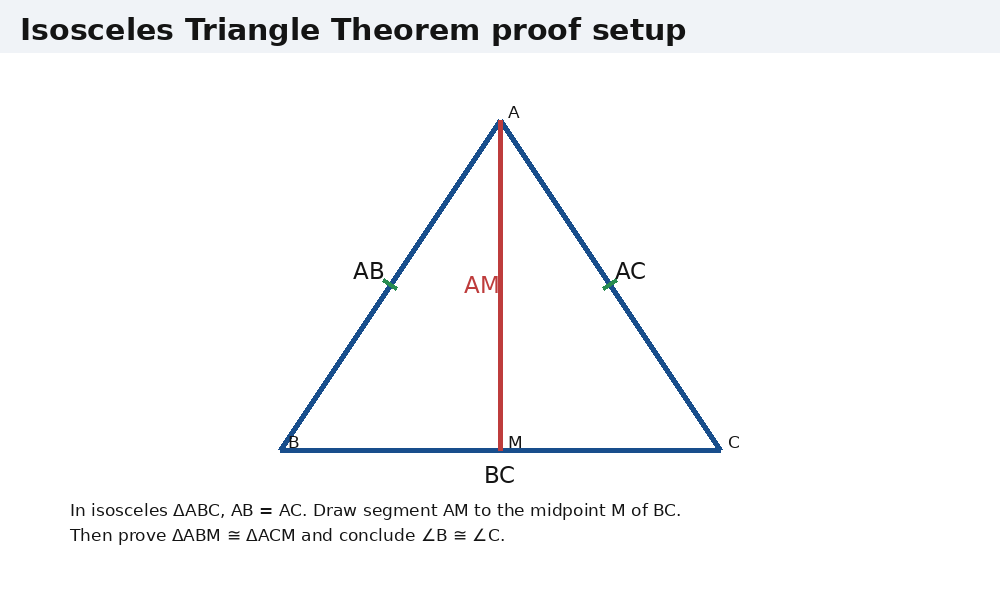
Proof Example D · Isosceles Triangle Theorem
Show proof outline
- Given AB = AC, choose point M as the midpoint of BC.
- Then BM = MC, and AM is shared.
- So ΔABM ≅ ΔACM by SSS.
- Therefore corresponding base angles are congruent, so ∠B ≅ ∠C.
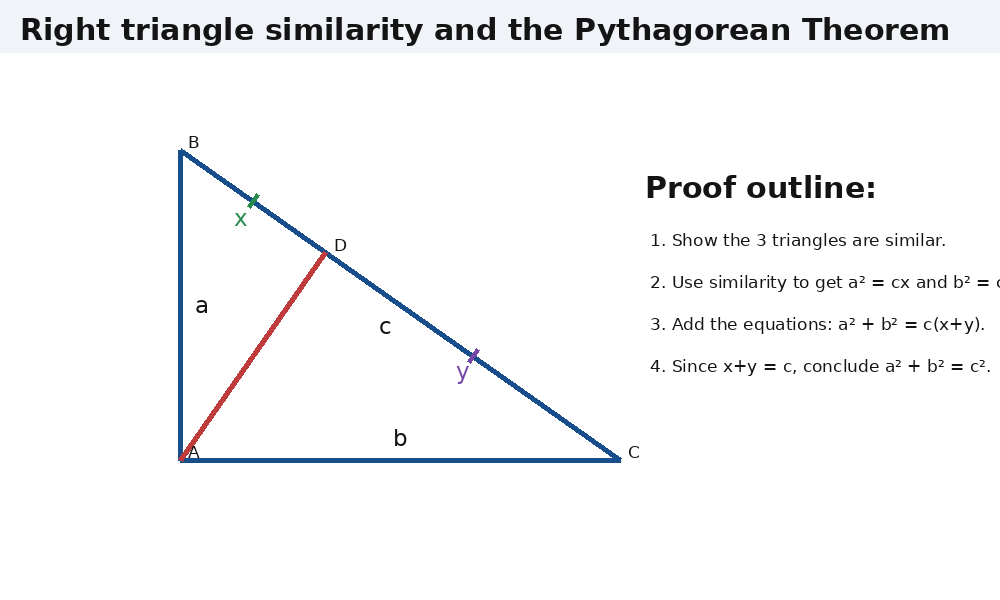
Proof Example E · Right Triangle Similarity and the Pythagorean Theorem
Show proof outline
- Show that the three right triangles in the diagram are similar.
- Use similarity to derive a^2 = cx and b^2 = cy.
- Add the equations: a^2 + b^2 = c(x+y).
- Because x+y = c, conclude a^2 + b^2 = c^2.
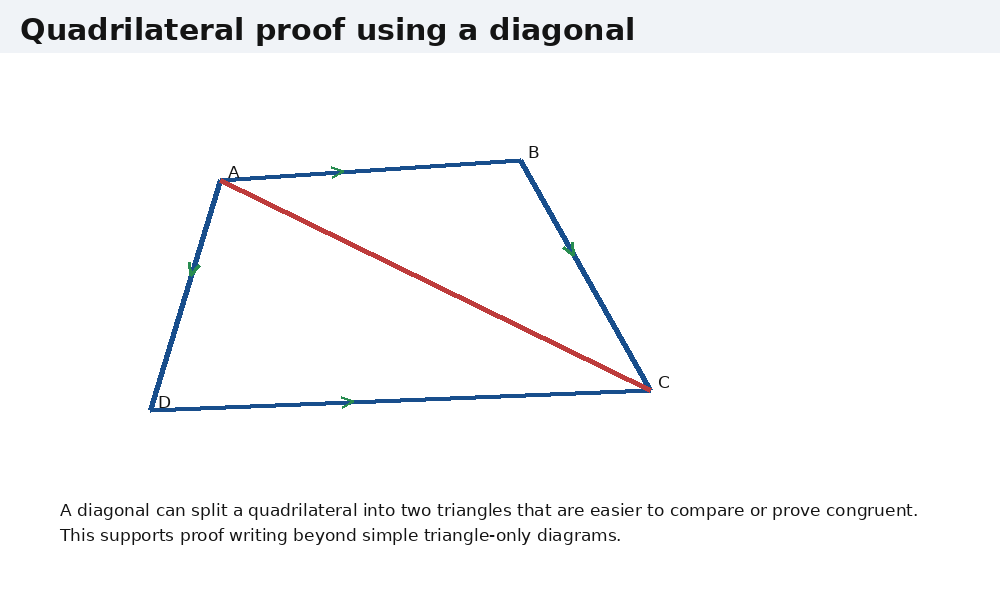
Proof Example F · Using a diagonal in a quadrilateral proof
Show proof strategy
- Draw a diagonal to decompose the quadrilateral into two triangles.
- Use the parallel side markings to identify angle relationships.
- Then prove the two triangles congruent or similar as needed.
- Finally transfer that result back to the quadrilateral.
Equations & Rules
Similarity check
Corresponding angles are congruent and corresponding side ratios are equal.
a₁ / a₂ = b₁ / b₂ = c₁ / c₂
Scale factor
State it in the direction requested.
k = image / original
AA similarity
If two angles match, the triangles are similar.
Very common when parallel lines appear inside a triangle.
SOH
sin θ = opposite / hypotenuse
CAH
cos θ = adjacent / hypotenuse
TOA
tan θ = opposite / adjacent
Video Library
Unit 4 Review Sheet
Quiz 1 review · Lessons 4.1–4.3
- Can you match corresponding sides and angles from a picture?
- Can you write and solve a proportion from similar triangles?
- Can you organize the three triangles created by an altitude to the hypotenuse?
Quiz 2 review · Lessons 4.4–4.5
- Can you label opposite, adjacent, and hypotenuse correctly for a chosen angle?
- Can you choose sine, cosine, or tangent based on the picture?
- Can you use inverse trig to find an angle?
- Can you turn a word problem into a right triangle sketch?
Additional Unit 4 Standards · Visual Lessons and Practice
These lessons fill the items in the supplied standards checklist that were not explicitly taught on the published Unit 3 page or in the five-lesson Unit 4 sequence. Keep the existing quiz numbering; use these as preparatory and extension lessons with an additional cumulative assessment.
Congruence, Corresponding Parts, and Algebra
New coverage: properties of congruent segments, angles, and circles; matching polygon vertices; writing congruence statements; algebra with congruent triangles; congruence as a special case of similarity. Segments with identical lengths are congruent; angles with equal measures are congruent; circles with equal radii are congruent.
Worked example
If ΔABC ≅ ΔDEF in that order, then AB ↔ DE, BC ↔ EF and AC ↔ DF. If AB = 3x + 2 and DE = 17, then 3x + 2 = 17, so x = 5.
Draw this first
Sketch two triangles. Place one, two, or three side tick marks on corresponding sides. Label matching angles with the same number of arcs. Read corresponding vertices in the same order.
Circle connection: draw two circles with centers O and P and both radii 4 cm. They are congruent. A circle of radius 6 cm is similar to them by dilation, but not congruent.
Skills check · 4.0A
Given ΔPQR ≅ ΔSTU, list three matching side pairs and three matching angle pairs. If QR = 5y − 1 and TU = 24, find y. Answer: PQ ↔ ST, QR ↔ TU, PR ↔ SU; ∠P ↔ ∠S, ∠Q ↔ ∠T, ∠R ↔ ∠U; y = 5.
Rigid Motions, Isometries, and Similarity Transformations
New coverage: translation, reflection, rotation, dilation, sequences of isometries, and similarity transformations for polygons and circles. A rigid motion preserves distances and angle measures; a dilation preserves angles and multiplies lengths by the scale factor.
Draw this first
Use a coordinate grid. Draw the original triangle and its image. Label all coordinates. Trace each motion with an arrow and name its rule.
Worked example
A(1,1), B(3,1), C(1,3) translate by (4,−2) to A′(5,−1), B′(7,−1), C′(5,1). Translation is an isometry, so the triangles are congruent. Then dilate by k = 2 about the origin: the resulting image is similar, with twice the side lengths.
How to test figures: if a sequence of reflections, rotations, and translations maps one figure onto another, the figures are congruent. If a dilation is also needed, they are similar; if its scale factor is 1, congruence is a special case.
Skills check · 4.0B
Reflect P(2,1), Q(4,1), R(2,3) across the y-axis, then translate right 5 units. Answer: P′(3,1), Q′(1,1), R′(3,3). Name the isometries and explain why lengths remain unchanged.
Classifying Triangles and the Isosceles Triangle Theorem
Classify by sides: scalene, isosceles, equilateral. Classify by angles: acute, right, obtuse. An isosceles triangle has congruent base angles; conversely, congruent angles have congruent opposite sides.
Visual proof
Given AB = AC, construct a bisector of ∠A meeting BC at D. By SAS, ΔABD ≅ ΔACD (AB = AC, AD shared, ∠BAD = ∠DAC). Therefore ∠B = ∠C. For the converse, bisect ∠A and use AAS congruence to conclude AB = AC.
Worked example
If AB = AC and ∠B = (3x+5)°, ∠C = (5x−15)°, set 3x+5 = 5x−15, giving x = 10. Both base angles are 35°, so the vertex angle is 110°.
Skills check · 4.0C
An isosceles triangle has vertex angle 44°. Find each base angle and classify the triangle by sides and angles. Answer: 68°, 68°; isosceles and acute.
Medians, Altitudes, and Geometric Constructions
A median connects a vertex to the midpoint of the opposite side; an altitude passes from a vertex perpendicular to the opposite side (or its extension). They can overlap in some triangles, but are not generally the same segment.
Construction stations
Equilateral triangle: draw AB; draw circles of radius AB centered at A and B; use an intersection as C. Square: construct a perpendicular at A to AB, mark AD = AB, then construct parallels through B and D. Regular hexagon: draw a circle and step off the radius around its circumference six times.
Regular n-gons and symmetry
For a regular n-gon, equal central angles measure 360°/n. Use a protractor or digital geometry tool to place successive vertices on a circle. An ideal compass-and-straightedge construction is not possible for every n. A regular n-gon has n reflection axes and rotational symmetry in increments of 360°/n.
Skills check · 4.0D
Draw a scalene triangle; construct one median and one altitude from the same vertex and explain why they need not overlap. Then sketch a regular hexagon with all six reflection axes.
Side Splitting Theorem and Its Converse
Side splitting theorem: if DE ∥ BC, then AD/DB = AE/EC. This follows from AA similarity between ΔADE and ΔABC and proportional corresponding sides. Converse: if D lies on AB and E lies on AC, and AD/DB = AE/EC, then DE ∥ BC.
Proof idea for the converse
Through D, draw a line parallel to BC meeting AC at E′. The theorem gives AD/DB = AE′/E′C. If E already divides AC in the same ratio, E = E′ (uniqueness of the division point), so DE ∥ BC.
Worked example
AD = 6, DB = 4, AE = 9, EC = x. Then 6/4 = 9/x, so 6x = 36 and x = 6.
Skills check · Side splitting
AB is split into AD=8 and DB=12; AC into AE=10 and EC=15. Must DE be parallel to BC? Answer: Yes; 8/12 = 10/15 = 2/3, so the converse applies.
Right Triangle Similarity and a Proof of the Pythagorean Theorem
Construct an altitude from the right angle to the hypotenuse, dividing hypotenuse c into segments p and q. Similarity gives a² = cp and b² = cq for the two legs a and b. Add the equations: a²+b² = c(p+q) = c². This proves the Pythagorean Theorem through similar triangles.
Visual prompt: label a, b, c, p, q and the altitude; trace each of the three similar triangles before writing the ratios. This connects the theorem to the existing 4.3 lesson.
Skills check · Pythagorean proof
Explain why p+q=c, and use the two proportions a²=cp and b²=cq to derive a²+b²=c². Then find the hypotenuse of a right triangle with legs 9 and 12. Answer: 15.
Pythagorean Theorem, Simplifying Radicals, and Missing Sides
Write square roots in simplest radical form by factoring out a perfect square: √72 = √(36·2) = 6√2. In exact answers, do not automatically convert a radical to a decimal.
Worked example 1
Legs 6 and 8: c² = 6² + 8² = 100, so c = 10.
Worked example 2
Hypotenuse 10, one leg 6: x² = 100 − 36 = 64, so x = 8. For legs 6 and 6: c = √72 = 6√2.
Skills check · 4.6A
Find the exact hypotenuse of a right triangle with legs 4 and 8. Answer: √80 = 4√5.
45–45–90 and 30–60–90 Triangles
45–45–90: the side ratio is x : x : x√2. 30–60–90: the side ratio is x : x√3 : 2x, with x opposite 30°, x√3 opposite 60°, and 2x opposite 90°.
Worked example 1
45–45–90 with leg 7: the other leg is 7, and the hypotenuse is 7√2.
Worked example 2
30–60–90 with hypotenuse 18: the short leg is 9 and the long leg is 9√3.
Angle recognition: if a right triangle's two legs are equal, its acute angles are 45° and 45°. If its side ratios are 1 : √3 : 2, the acute angles are 30° and 60°.
Skills check · 4.6B
A right triangle has legs 5 and 5. Find its acute angles and exact hypotenuse. Then find both legs if a 30–60–90 triangle has hypotenuse 14. Answers: 45°, 45°, 5√2; short leg 7, long leg 7√3.
Triangle/Polygon Proof Connections, Quadrilaterals, and Area
Proofs from diagrams
Triangle sum: draw through one vertex a line parallel to the opposite side; alternate interior angles form a straight angle, so the triangle's angles sum to 180°. Quadrilateral sum: a diagonal makes two triangles, so 2·180° = 360°. Convex n-gon: n−2 triangles imply (n−2)180°.
Special quadrilaterals and area formulas
Draw the family: parallelogram → rectangles, rhombi, squares; trapezoids → isosceles trapezoids. Use decompositions to justify A(triangle)=bh/2, A(parallelogram)=bh, A(trapezoid)=(b₁+b₂)h/2, A(kite)=d₁d₂/2.
Parallelogram theorem proof: draw diagonal AC in parallelogram ABCD. Since AB ∥ CD and BC ∥ AD, alternate interior angle pairs are congruent; the triangles share AC. By ASA, ΔABC ≅ ΔCDA, proving opposite sides congruent. Theorem versus converse: a theorem moves from its hypothesis to its conclusion; the converse reverses them and must be justified separately.
Triangle inequality reasoning: traveling from A to C through B is longer than the direct segment AC for a non-collinear triangle, so AB + BC > AC; repeat for the other side pairs.
Proof of a trapezoid area formula: place two congruent trapezoids together to make a parallelogram with base b₁+b₂ and height h. Divide its area by two. Modeling example: a trapezoid garden has bases 8 m and 14 m and height 5 m; its area is (8+14)·5/2 = 55 m².
Skills check · 4.6C
A quadrilateral is split by a diagonal. Explain why its interior angle sum is 360°. Then calculate the area of a kite with diagonals 10 and 16. Answer: two 180° triangles; 80 square units.
Cumulative readiness checklist
Before the final unit task, check whether you can draw/label corresponding congruent parts; perform isometries and dilations; use isosceles triangle properties; distinguish a median from an altitude; justify side splitting and its converse; prove Pythagoras using right triangle similarity; simplify radicals; recognize special right triangles; and make geometric arguments about polygons and area formulas.
Performance Task: Community Observation Tower
The build
Design a community observation tower. Your design should include a scale drawing, one use of similarity, and one use of right triangle trigonometry.
Required submission
Extended option: demonstrate a rigid motion or dilation of your plan, use a 30–60–90 or 45–45–90 triangle, and justify an area calculation using a labeled decomposition.
- A labeled drawing of the tower
- At least one similarity or proportional reasoning calculation
- At least one trig or inverse trig calculation
- A short explanation of how the picture helped you set up the math
Example design starter
Sketch the tower from the side. Add a diagonal support beam or a line of sight from an observer on the ground. Then label the known and unknown values clearly before solving.
Rubric · 40 points
| Category | Description | Points |
|---|---|---|
| Visual model | Scale drawing is neat, labeled, and mathematically useful. | 10 |
| Similarity reasoning | Uses similar figures or triangles correctly. | 10 |
| Trig reasoning | Uses SOH-CAH-TOA or inverse trig correctly. | 10 |
| Explanation | Explains the process clearly and connects the math to the drawing. | 10 |
Next Step: Code a Right-Triangle Investigation
After completing the right-triangle lessons, check similarity calculations with supported code, then write your own field-measurement solver. Draw and label the triangle before choosing a trigonometric relationship.
- Explore similarity and right triangles with supported code →
- Write a Trigonometry Field-Measurement Solver →
Predict first, build and run your program in the browser sandbox, then use the results to explain your model. Download your lab record when you finish.